

THIS IS OUR FUTURE
Bannock County Planning & Development Services is drafting a comprehensive Land Use & Development Ordinance to replace current zoning code.
Land Use & Development Ordinance
What is a Land Use & Development Ordinance?
A Land Use & Development Ordinance is a local rule that tells people how land in a community can be used, built on, or divided. It helps guide growth and follows the community’s comprehensive plan (see ours).
Right now, Bannock County has eight different ordinances that cover different parts of land use and development.
Planning & Development Services is suggesting a new update. They want to combine all eight ordinances into one clear and simple rule. This change would make the rules easier to understand, save time, and remove any parts that are confusing or redundant.
Current Ordinance and Code
View the current ordinances and codes that a comprehensive Land Use & Development Ordinance will replace.
Zoning Ordinance
Subdivision Ordinance
Building Code Ordinance
Sediment and Erosion Control Ordinance
Flood Zone Ordinance
Solid Waste Ordinance
Illicit Discharge and Stormwater Sewer Connection Ordinance
Stormwater Management Ordinance
What's Next?
Projected Project Timeline
Phase 1: Draft Refinement & Analysis
January – Mid-February
-
Refine the initial draft
-
Incorporate public input and technical data
-
Conduct mapping and data coordination
-
Prepare a revised working draft
Phase 2: Legal Review & Advisory Workshops
Mid-February – March
-
Legal review and revisions
-
Advisory Committee, Planning Council, and Commission workshops
-
Prepare an updated draft based on feedback
Phase 3: Post-Workshop Revisions
Late March – Early April
-
Incorporate direction from workshops
-
Complete required legal and policy analyses
Phase 4: Public Hearing Draft Preparation
Mid-April
-
Finalize draft for public hearings
-
Complete maps and supporting materials
Phase 5: Public Hearings
Late April – Early June
-
Planning Council public hearing
-
Commission public hearing
-
Additional hearings if significant changes are required
Phase 6: Adoption & Publication
Mid-June – Early July
-
Final edits and legal review
-
Formal adoption
-
Publication and effective date
What changes are being proposed?
Planning & Development aims to consolidate and modernize eight existing ordinances into a comprehensive Land Use and Development Ordinance (LUDO) for Bannock County. This ordinance will regulate zoning, land use, subdivision, and other key aspects of county planning.
Goals:
- Enhance clarity, consistency, and enforceability
- Align with state and federal regulations
- Use the Comprehensive Plan to guide the ordinance
Proposed Changes:
| Type of Land | Current Zoning Requirements | Proposed Zoning Requirements |
| AGRICULTURAL (AG): | 40 Acres | 40 Acres |
| COMMERCIAL GENERAL (CG): | 1 Acre | 1 Acre |
| INDUSTRIAL (I): | 1 Acre | 2 Acres |
| LIGHT INDUSTRIAL (LI): | 1 Acre | 1 Acre |
| MULTIPLE USE (MU): | 1 Acre; lacks clarity when proposing use | Acreage will be dependent on proposed use. Section will provide framework for requesting uses. |
| RECREATIONAL (R): | 1 Acre | 5 Acres |
| RESIDENTIAL RURAL (RR): | 5 Acres | 5 Acres |
| RESIDENTIAL SUBURBAN (RS): | 5 Acres | 1 Acre |
| SPECIAL LANDS (SL): (federal, state, and public lands) | No clarity | Provide framework for requesting special use zoning. |
Zoning Definitions
AGRICULTURAL (AG): Agricultural zoning should preserve farmland, protect natural resources, and maintain the rural character of a community by preventing urban sprawl. It should support sustainable farming practices, local economies, and provide buffers between urban and rural areas. This zone should ensure long-term agricultural use while promoting environmental protection and food security.
COMMERCIAL GENERAL (CG): Commercial General zoning should allow for a broad range of commercial uses that meet community and regional needs. It should support economic growth by concentrating businesses in areas with suitable infrastructure and access. This zone should help manage land use by separating intensive commercial activity from residential and industrial zones.
INDUSTRIAL (I): Industrial zoning should accommodate manufacturing, processing, warehousing, and other intensive industrial uses. It should ensure these activities are located in areas with appropriate infrastructure, access, and separation from residential or commercial zones to minimize land use conflicts. This zone should support economic development while protecting public health, safety, and the environment.
LIGHT INDUSTRIAL (LI): Light Industrial zoning should allow for low- to moderate-impact industrial uses such as light manufacturing, assembly, warehousing, and distribution. It should support economic activity while maintaining compatibility with nearby commercial or residential areas through performance standards that limit noise, emissions, and heavy traffic. This zone should provide space for industrial growth with less intensive impacts on surrounding land uses.
MULTIPLE USE (MU): Multiple Use zoning should apply to areas with existing mixed residential and non-residential development and allows uses otherwise permitted according to the surrounding uses. It is intended to be transitional and may be rezoned over time to districts reflecting the predominant land use as development occurs. Development shall be compatible with surrounding uses through buffering and control of external effects. Uses that are incompatible with surrounding uses or whose impacts cannot be adequately mitigated shall not be permitted.
RECREATIONAL (R): Recreational zoning should provide space for outdoor and indoor recreational uses, including parks, campgrounds, trails, and public or private recreational facilities. It should support community health, tourism, and quality of life by preserving areas for leisure, sports, and natural enjoyment. This zone should help to manage land use to ensure recreational activities are compatible with surrounding development and environmental resources.
RESIDENTIAL RURAL (RR): Residential Rural zoning should allow for low-density residential development in a rural setting, often with larger lots and limited infrastructure. It should support a quiet, countryside lifestyle while accommodating some agricultural or home-based activities. This zone should preserve a rural character, serving as a buffer between more urbanized areas and agricultural or natural lands.
RESIDENTIAL SUBURBAN (RS): Residential Suburban zoning should support medium-density residential development with a suburban character, typically including single-family homes on moderate-sized lots. It should be intended to accommodate growth near urban areas while providing a balance between rural and more compact residential neighborhoods. This zone should promote orderly development with access to essential services and infrastructure.
SPECIAL LANDS (SL): Special Lands zoning should identify and regulate land subject to federal, tribal, or state jurisdiction where ownership, management, and permitted uses differ from standard county zoning districts. This includes, but is not limited to: Bureau of Land Management (BLM) lands, U.S. Forest Service lands, State of Idaho Department of Fish and Game lands, Fort Hall Indian Reservation lands held in fee simple (privately owned, not held in trust), or other lands under special jurisdiction or cooperative management. The intent of this district is to recognize and coordinate with applicable managing agencies or jurisdictions, ensure uses are consistent with county land use policy while respecting the authority of the managing entity, and provide a process for review and approval of new or changed uses.
Bannock County currently has “Open Space” requirements. We are proposing removing all open space requirements from the ordinance. Open Space: Land restricted from development, as defined in Bannock County Subdivision Ordinance 1997-4.
Open Space: Land restricted from development, as defined in Bannock County Subdivision Ordinance 1997-4.
| Current Code | Proposed Changes |
| Requires property owners to maintain 50% of their land as “open space” | No longer required |
| Allows only one contiguous piece of land to fulfill open space requirement | No longer required |
| Required to have open space in all areas of wildlife habitat areas (based of Fish & Game maps) | No longer required |
Currently, Bannock County allows a Minor Land Division (MLD) for developers and property owners who want to divide their property into four or fewer parcels. Planning & Development is proposing changing the MLD system for a Short Plat system.
| Minor Land Division (MLD) – Current System | Short Plat – Proposed System |
| Requires a “record of survey” to create four (4) or fewer parcels | Would require a pre-development application to be reviewed by Planning & Development staf |
| “Record of Survey” is a map created by a licensed land surveyor that provides a record of a property’s boundary lines, easements, and other features as determined by a survey | A pre-development application would include a conceptual plan of the proposed subdivision, agency review, an on-site review of the property, and a pre-development meeting with Bannock County Staff. |
| Planning & Development staff review and approve MLD requests | Board of County Commissioners would review and approve the final plat request |
| Does not create an official division and does not codify any easement or deed restrictions set during MLD process | Would create a legally binding land division, easement, or deed restrictions set during the application process |
Alternative Energy
Bannock County’s current ordinance bans all large-scale solar, wind, and nuclear energy projects.
Background: In 2024, Bannock County Commissioners banned large-scale solar and wind projects in the county following the expiration of a temporary moratorium on these types of projects. Watch the public hearing and vote on the ordinance. Since the ordinance was enacted, Planning & Development has been investigating other county ordinances that allow certain alternative energy projects while protecting the natural environment, property owners rights, and taxpayer interests.
What is Being Proposed:
- Allow wind, solar, and nuclear energy as a Conditional Use Permit (CUP), with extensive requirements
- Requirements: Emergency Plan; Erosion and Sediment Control Plan; Fire Protection Plan; Fish, Wildlife, and Native Plant Protection Plan; Visual Impact Analysis; Extensive Setback Requirements; Termination and Decommissioning Plan; Public Hearing as Conditional Use Permit; Wildlife Studies; Transportation Plan; Weed Control Plan
- Allow a CUP for wind and solar in the following zones:
- Agricultural, Commercial General, Industrial, and Light Industrial
- Allow a CUP for nuclear in the following zones:
- Commercial General, Industrial, and Light Industrial
Public Input Opportunities
Previous Input Opportunities
Several Opportunities have been held throughout the years to gather input from the public about what they desire from county development, zoning, and land use ordinances. For each of these efforts, we promoted the surveys through county social media channels, press releases, our news release distribution list, and other outreach methods.
In 2022, we conducted a public survey titled “Open Space/Subdivision Ordinance,” which focused on open space requirements. The survey was open from February 7 through March 21, 2022, and received 707 responses.
In 2023, we gathered additional public input through the “Land Use Ordinance” survey, which solicited feedback related to zoning. This survey was open from January 26 through March 6, 2023, and received 186 responses.
In 2025, we conducted a broader outreach effort titled “Land Use & Development Ordinance Update.” This survey addressed all ordinances and was open from September 17 through October 23, 2025. We received 638 responses during this period.
Upcoming Input Opportunities
Public Hearings
Late April – Early June
Public hearings are your chance to share feedback on the proposed ordinance draft. Testimony can be shared in person or via email. More details will be published when the hearings are scheduled.
-
Planning Council public hearing
-
Commission public hearing
-
Additional hearings if significant changes are required
Hearing dates will be posted here when they are scheduled. Hearings may be broadcast live on our YouTube page.
Comprehensive Plan
What is a Comprehensive Plan?
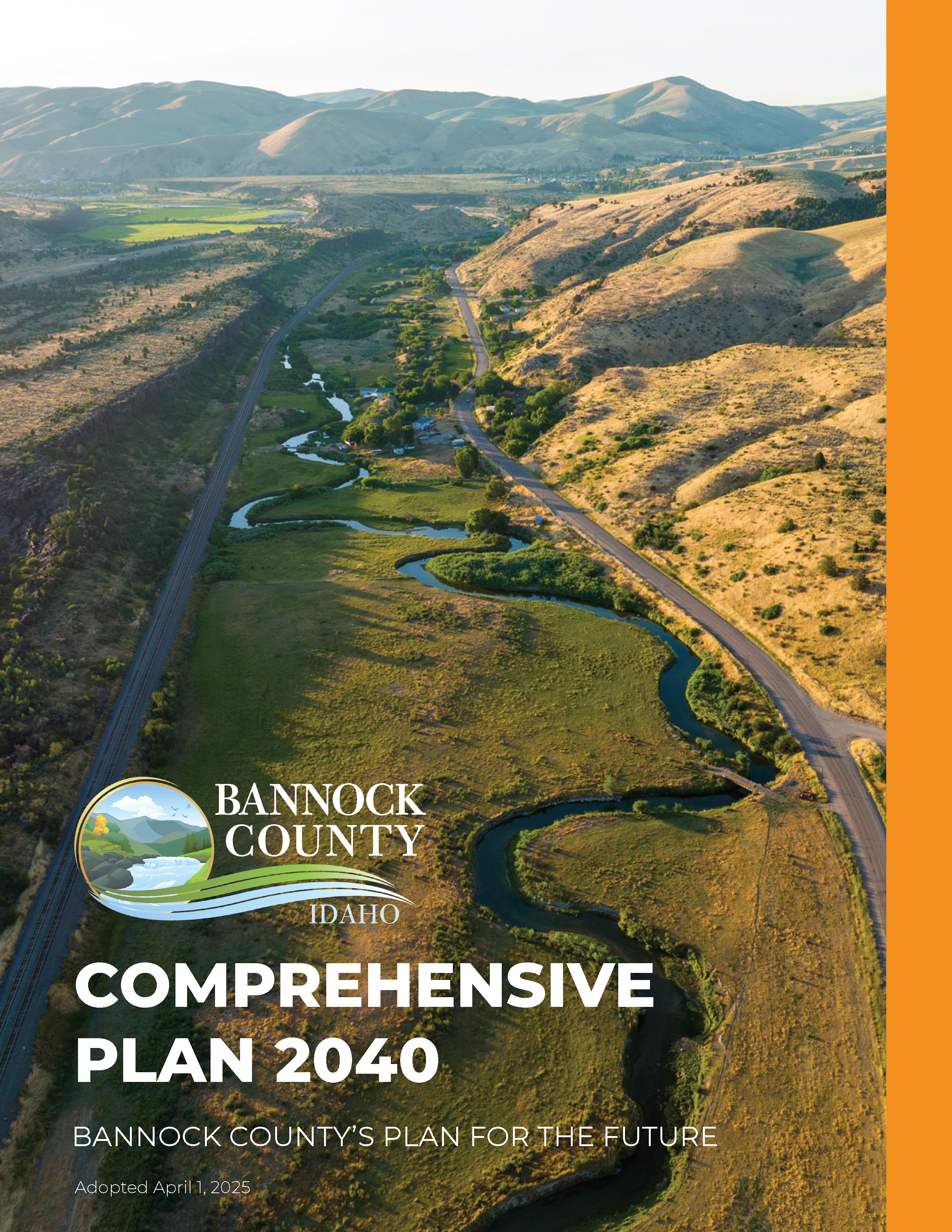
Bannock County’s Comprehensive Plan outlines a 20-year vision to be economically vibrant, encourage sustainable development, and enhance our rural, recreational, and agricultural character. The plan helps us make decisions about future projects and determine the location and extent of future development.
The comprehensive plan encompasses the entire county, including those lands managed by Tribes and federal and State agencies. Areas within a city’s limits are not included in the Bannock County Comprehensive Plan.
Planning & Development
Office hours are:
Monday – Thursday 8:00 a.m. – 5:00 p.m.
Friday 8:00 a.m. – 2:00 p.m.
Closed all federal holidays.
5500 S. 5th Avenue
Pocatello, ID 83204
Google Map with directions
Phone: 208-236-7230
Fax: 208-232-2185
Email: zoning@bannockcounty.gov
Get Updates
Sign up to receive updates from Bannock County, such as Planning & Development Council Agendas, Commissioner Agendas, and more!

