

Fort Hall Mine Landfill Groundwater Remediation
Bannock County is actively cleaning up chemicals in groundwater coming from an old, now closed, part of Fort Hall Mine Landfill. The chemicals, including trichloroethene (TCE), tetrachloroethene (PCE), and other volatile organic compounds (VOCs), pose very limited risk to nearby residents. We are directly communicating with the residents whose wells are impacted by the chemicals.
Click through the tabs below to learn more about the clean-up effort. Hover over words in blue to see definitions.
- Site Information
- Site History
- Groundwater Contamination
- Clean-Up Status
- What is the risk?
- Pilot Study
- FAQ Page
- Documents
- Glossary
Site Information
Site Name: Fort Hall Mine Landfill
Location: Pocatello, Idaho
Landfill Operation Start: 1943
Contamination Source Area: Cell 1- unlined disposal area (closed 1993)
Chemicals of Concern (COCs): Chlorinated solvents, including trichloroethene (TCE), tetrachloroethene (PCE), and vinyl chloride.
Remediation Start: 2002
The Problem: Landfill users disposed of hazardous chemicals in Cell 1, an unlined disposal area. This resulted in the uncontrolled release of chemicals into groundwater, impacting the Portneuf Valley Aquifer, which supplies drinking water to most Bannock County residents. A remediation system began operation in 2002 but does not fully prevent all contamination from reaching the aquifer.
The Solution: Bannock County began detailed investigations in 2019 to understand why the groundwater remediation system was not fully effective. Since then, the County has upgraded the existing remediation system to improve its performance and collected additional data from the system and groundwater monitoring wells. The County has also conducted tracer and pilot studies to understand COC movement in groundwater and to test new remediation approaches and technologies.
Click on the video and tabs above to learn more about contamination at site and what Bannock County is doing to clean it up.
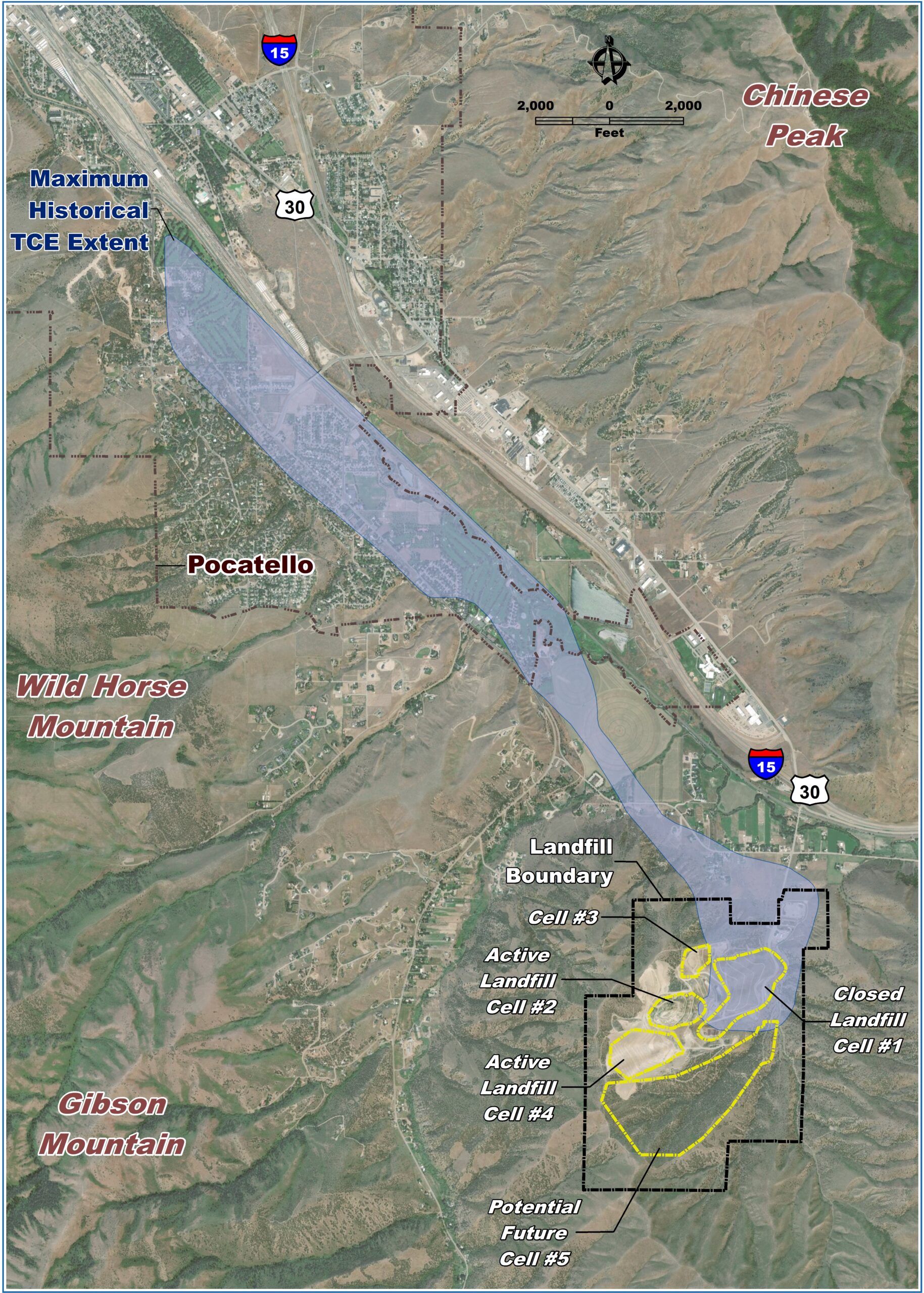
Site and contamination location. Click image to enlarge.
Hear from experts about how the clean-up works (progress shown in video as of 2021)
Site History
Landfill Operations Timeline
1943-1973 – Private operation of the landfill
1973-1976 – City of Pocatello purchases and operates the landfill
1976 – Idaho legislation requires all solid waste disposal facilities to come under county level control
1976-1979 – Landfill operation contracted to Snake River Sanitation Company
1979-Present – Bannock County operates the landfill
1993 – Bannock County closes Cell 1
Investigation Timeline
1991 – Groundwater Contamination discovered in City of Pocatello drinking water supply wells
1993 – Idaho Department of Environmental Quality (IDEQ) issues consent order to Bannock County to investigate and remediate the groundwater contamination from Cell 1
2000 – County completes Cell 1 contamination investigation
2014 – IDEQ determines treatment is ineffective and additional actions are required
2016 – IDEQ issues new consent order to Bannock County
2018 – Bannock County hires new environmental contractor, CDM Smith
2019-2020 – Expanded site investigation activities
Remediation Timeline
2002- Present – Bannock County constructs and operates groundwater remediation system
2019-2021 – Remediation system repairs and upgrades
2023 – Phase I Pilot Study
2025 – Phase II Pilot Study
Groundwater Contamination
What is the contamination?
- Chemicals of Concern (COCs): Chlorinated solvents, including trichloroethene (TCE), tetrachloroethene (PCE), and vinyl chloride.
- These are volatile organic chemicals that are harmful to human health.
- TCE and PCE are chemicals that dissolve oil and grease.
- These chemicals were used in dry cleaning, machining, industry, degreasing, adhesive and refrigerant manufacturing, and stripping applications.
- The federal Safe Drinking Water Act and Idaho Department of Environmental Quality regulations state that people should not drink water containing more than 5 micrograms per liter (µg/L) of either TCE or PCE. Click on the “What is the Risk” tab to learn more.
Where does the contamination come from?
- Fort Hall Mine Landfill Cell 1, which is unlined, meaning it lacks the barrier between the waste and the surrounding environment that is now required at landfills.
- Click on the “Site History” tab to learn more.
Where do the chemicals go?
- Disposal of chemicals from Cell 1 resulted in the release of COCs into groundwater, impacting the Portneuf Valley Aquifer, which supplies drinking water to most Bannock County residents.
- TCE above 5 (µg/L) historically traveled about four and a half miles from the landfill boundary in groundwater to City of Pocatello drinking water supply wells.
- The monitoring program samples groundwater twice a year at the landfill and once a year at nearby properties to help Bannock County learn about chemical levels and how chemicals move.
- The area of contaminated groundwater has decreased over time as cleanup efforts progressed.
- Now TCE over 5 (µg/L) travels about half a mile from the landfill boundary.
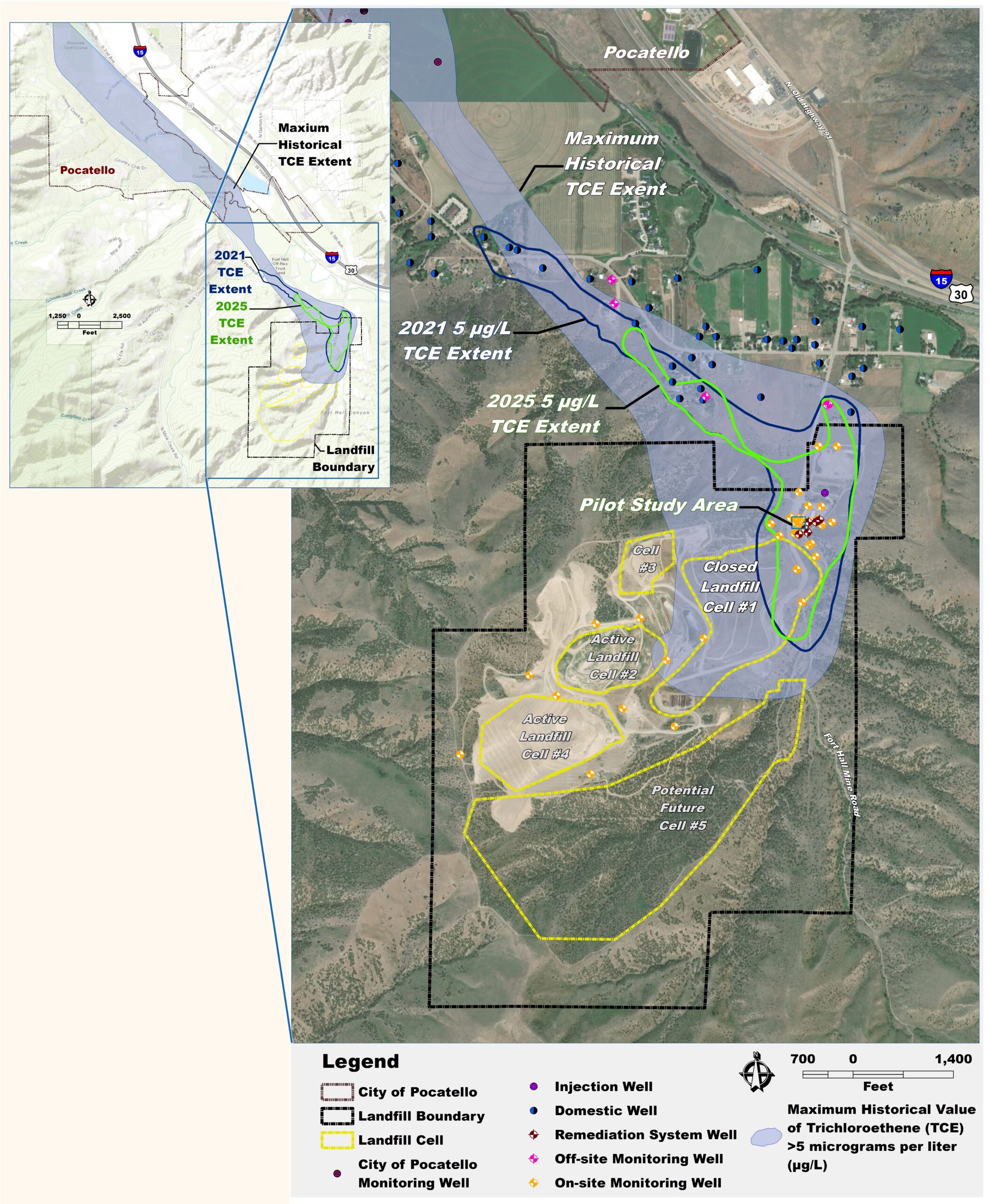
The groundwater contamination around Fort Hall Mine Landfill as of 2025. Click image to enlarge.
Clean-Up Status
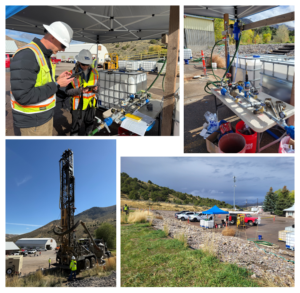
The project team working at the landfill.
Bannock County is actively cleaning up chemicals in groundwater coming from an old, unlined part of Fort Hall Mine Landfill (Cell 1). The county takes regular groundwater samples from private wells near the landfill and directly communicates with the property owners to share the results for their well.
Sampling takes place as follows:
- Twice a year for groundwater sampling in and around the landfill, including Cell 1
- Four times a year for remediation system sampling
- Once a year for groundwater sampling of private wells outside the landfill that may be impacted.
Since 2018, Bannock County has committed $12 million to clean up the groundwater affected by Fort Hall Mine Landfill. Bannock County currently uses a groundwater remediation system to remove trichloroethene (TCE) and tetrachloroethene (PCE).
- The system uses extraction wells to pump contaminated groundwater into an above-ground treatment building.
- The system removes the chemicals from the extracted groundwater and then re-injects clean water.
- Permit requirements for the system ensure that water is treated below federal and Idaho’s state regulatory levels.
In 2019, Bannock County began a new strategy to improve the remediation system. In 2022, Bannock County improved the remediation system, which included repairing and upgrading equipment like pumps and valves. In 2023, a pilot study began to investigate other approaches to cleaning up the groundwater. Phase I evaluated the effectiveness of a new, in place, approach to degrade TCE in the aquifer. Phase II expanded the in-place approach to evaluate other amendments and injection techniques. Click on the “Pilot Study” tab to learn more.
While Bannock County remediates chemicals leaching from the closed Cell 1 area, other areas of the landfill are still active. Cell 4 is currently active and receives waste. It is lined to prevent chemicals from waste placed on top of the liner from going into the environment.
What is the risk?
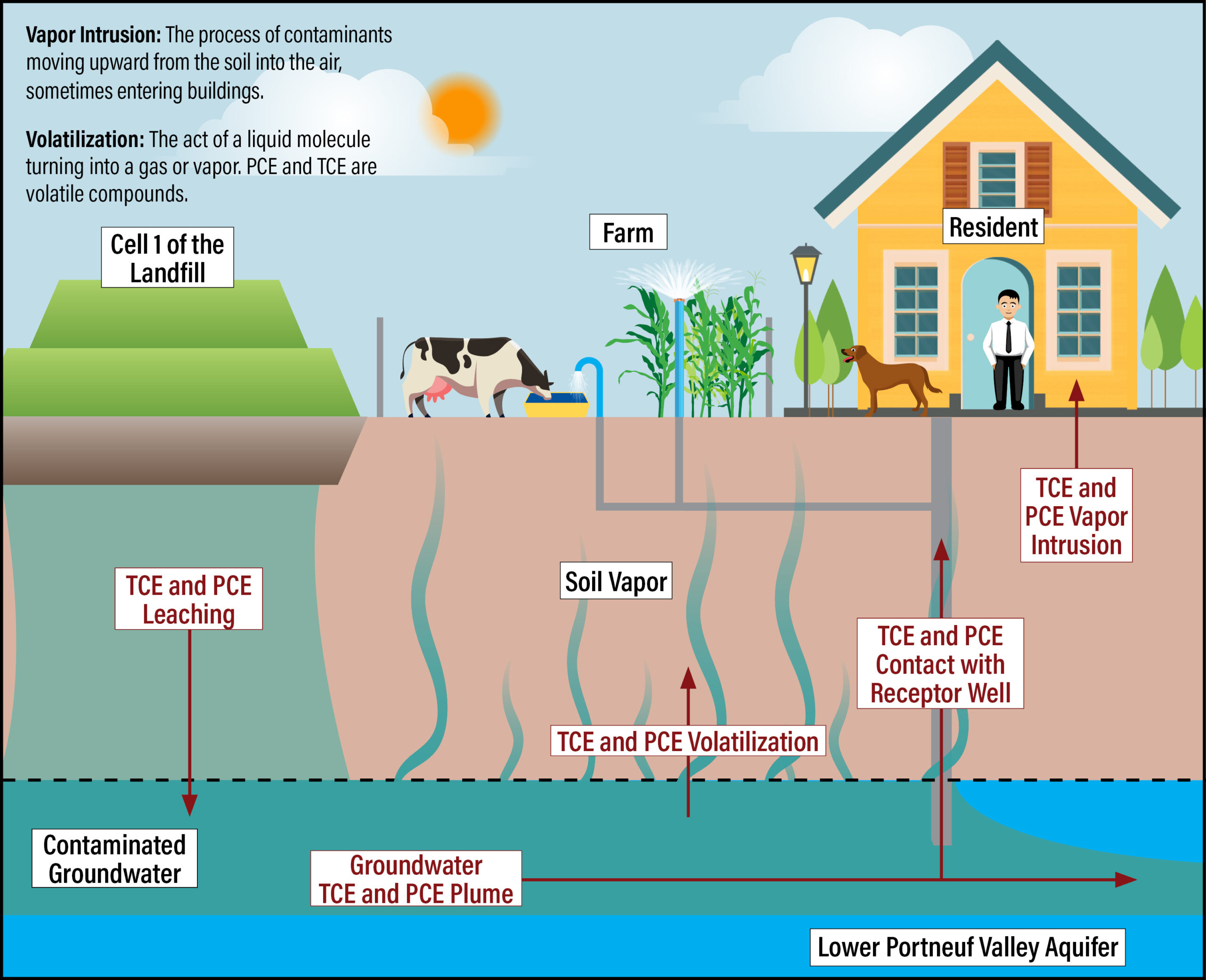
How trichloroethene (TCE) and tetrachloroethene (PCE) move through the environment. Click image to enlarge.
Sampling helps Bannock County learn about changes in chemical levels and how the chemicals move. Crews sample groundwater wells twice a year at the landfill and once a year at nearby properties. The results of these efforts are available in the monitoring reports on the “Documents” tab.
According to CDM Smith’s 2025 screening level risk assessment, water from some domestic wells may be unsafe to drink. We update the risk assessment after crews take samples from select domestic wells each summer. The results are available to the public in offsite monitoring reports in the “Documents” tab. None of the unsafe wells are used for drinking water supply, but we inform affected property owners in case they are used for drinking in the future. Private well water is safe to drink from most private wells in the area. City water is also safe to drink.
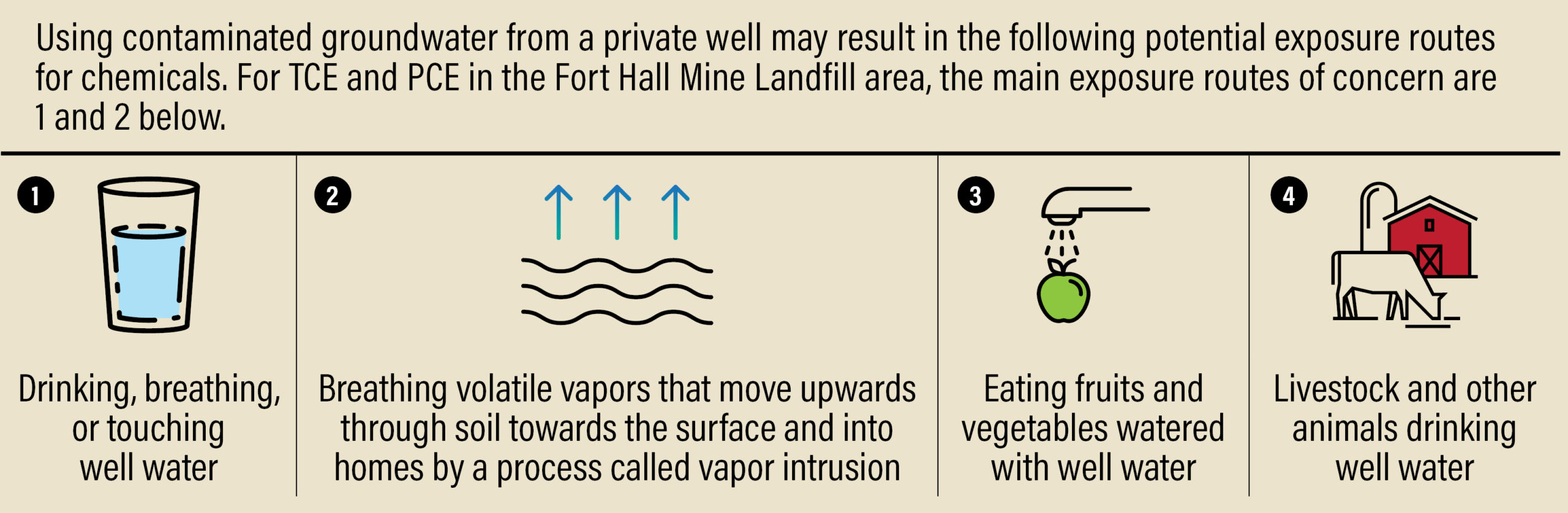
The different ways humans and animals can be exposed to TCE and PCE in the Fort Hall Mine Landfill area.
If my private well is contaminated, how can I be exposed to PCE and TCE?
Residents with contaminated private wells may be exposed to chemicals through:
- Drinking, breathing, or touching well water.
- Breathing vapors that move upward through soil and into homes by a process called vapor intrusion.
- Eating fruits and vegetables watered with well water.
- Livestock and other animals drinking well water.
We evaluate the sampling results to determine if you may be at risk from any of these exposures.
How did you determine risk to humans and the environment?
Our risk assessment looked at how humans and the environment could be exposed specifically to PCE and TCE, known as exposure routes. Exposure routes of concern for PCE and TCE are:
- Drinking, washing, or bathing with groundwater from a well.
- Breathing indoor air containing PCE or TCE through a process called vapor intrusion.
We compared groundwater results to United States Environmental Protection Agency’s (EPA’s) risk-based concentrations for each exposure route. EPA sets maximum contaminant levels (MCLs) for each chemical. An MCL is the maximum amount of a contaminant in drinking water allowed by EPA to be protective of public health. The PCE and TCE MCL are 5 micrograms per liter (µg/L) each. The Idaho Department of Environmental Quality water quality standards for PCE and TCE are also 5 (µg/L) each.
Are children more at risk from PCE and TCE concentrations in well water?
Yes. Children are often more at risk from chemicals in the environment than adults. Our risk assessment considers this, and the EPA MCLs are established to be protective of the most sensitive populations, like children.
Can drinking well water from my property affect my health?
Possibly, it depends on your well. The risk from drinking well water and using it for other household purposes, like showering and cooking, may be above the “safe” level in some of the domestic wells sampled. The “safe” level for PCE and TCE is less than 5 micrograms per liter (µg/L). Drinking well water from these wells above the “safe” level and using it for household purposes may be a health risk. We inform property owners and tenants if their well water poses a risk.
Do vapors in my home pose a risk to my health?
Based off 2025 sample data, no. The risk from breathing vapors from contaminated groundwater was not above the “safe” exposure level in the domestic wells sampled.
Will my pet/livestock drinking well water or using well water in my pond pose a risk to pet, livestock, and fish health?
No. Using well water as drinking water for pets, livestock, and fish is unlikely to pose a risk even at the highest PCE and TCE concentrations found in domestic well water from the aquifer. During the risk assessment, we looked at ecological risk screening levels for multiple mammals and fish. Using domestic well water for pets, livestock, and fish is considered safe because the highest PCE and TCE concentrations were less than ecological risk screening levels.
Does eating vegetables and other garden plants watered with well water pose a risk to my health?
No. PCE and TCE are volatile chemicals, meaning very little will be left in the water during irrigation. Any PCE and TCE remaining do not absorb well into vegetables. If the vegetables do absorb PCE and TCE, the chemicals will quickly move through the leaves into the air. Consuming vegetables irrigated with well water is considered safe.
Pilot Study
Phase I
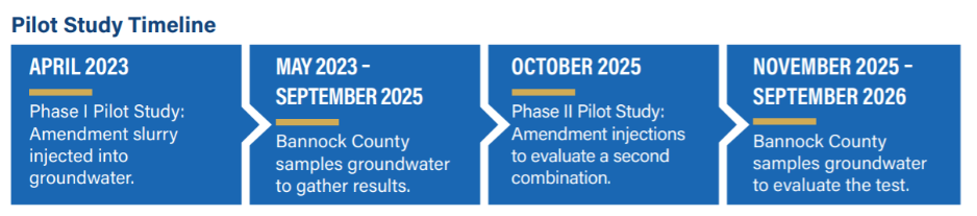
Bannock County injected an amendment slurry into groundwater to test if it could break down chemicals of concern (COCs) in a small test area.
- When: April 2023 (2 weeks)
- What: 50,000 gallons of amendment slurry injected
- Where: Two injection wells in a contaminated area near the landfill office within the treatment area
- Why: To evaluate if the amendment slurry breaks down groundwater COCs in the injection area. If the test is successful and trichloroethene (TCE) levels decrease, then Bannock County may use this cleanup technology on a larger scale to treat the groundwater.
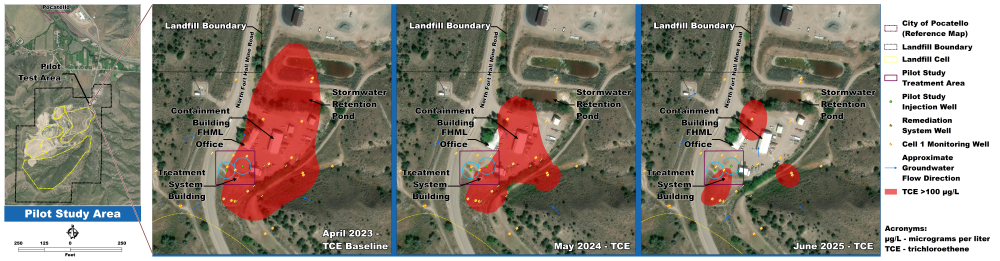
TCE>100 micrograms per liter (ug/L) decreasing in the pilot treatment area over time. Click image to enlarge.
From May 2023 to September 2025, Bannock County sampled nearby wells to check for changes to the groundwater after the first injection test. Groundwater sample results show that the amendment successfully degraded TCE and significantly reduced the contaminant plume and migration of contaminants of the landfill property. TCE concentrations decreased but then increased again in some wells because the pilot test was a small proof-of-concept.
Idaho Department of Environmental Quality (IDEQ) is reviewing Bannock County’s report on the first injection test. After their review is complete, a final report for the first injection test will be available under the “Documents” tab.
Phase II
In October 2025, Bannock County started a second (Phase II) injection test to evaluate another amendment combination with a different injection method in the treatment area.
- Bannock County will sample nearby wells for one year to evaluate changes in the COCs concentrations (through October 2026).
- The results from the Phase II injection test will give the County more information on how to improve the large-scale groundwater treatment strategy. The methods and amendments from both injection tests will be considered.
- After the monitoring period ends, Bannock County will provide a report for IDEQ review. After IDEQ approval, the report for the second injection test will be available under the “Documents” tab.
[AC_PRO id=40196]
Documents
Semiannual Groundwater Monitoring Reports and Appendices are added to this document list once reviewed and approved by Idaho Department of Environmental Quality (IDEQ).
Glossary
Amendment Slurry
A liquid mixture of substances that break down groundwater contaminants. Slurries can be injected into the ground to improve breakdown processes for many years.
Aquifer
An underground layer of soil or rock that is permeable enough for water to travel through and stay stored within. The groundwater within an aquifer exists in void spaces in the rocks and between pieces of soil, such as sands and silts.
Contamination
The presence of chemicals in the ground in high enough amounts to pose a risk to human health or the environment.
Chemicals of Concern
Chemicals that are at high enough concentration to be a risk (i.e. cause harm) to human health or the environment. For the Cell 1 contaminant plume, COCs were identified based on a risk assessment and are generally those that are present at levels above the maximum contaminant level (MCL) for drinking water.
Consent Order
A legally binding agreement between parties to take action.
Exposure Route
A pathway for a human or animal to come into contact with a chemical. Exposure routes can include breathing, eating, drinking, or skin contact. The most likely exposure routes for humans and TCE or PCE in Bannock County are through breathing or drinking.
Extraction Wells
Wells with pumps under ground that pull contaminated groundwater to the surface and into the treatment system.
Granular Activated Carbon
A commonly used material in remediation that can remove contaminants from water and vapor. Water or air flows through and the chemicals stick to the surface of the granules. Clean water or air then leaves the system, and the granules are disposed of once there is no more space on their surface for chemicals.
Groundwater
Groundwater is water that exists underground beneath the land surface. Groundwater flowing below the Fort Hall Mine Landfill enters the Lower Portneuf Valley Aquifer, the source of drinking water in Bannock County.
Maximum Contaminant Levels (MCLs)
The U.S. Environmental Protection Agency’s standards for the highest amount of a contaminant allowed in drinking water.
Micrograms per Liter (µg/L)
A unit of measurement for chemicals in water. One µg/L is about one drop of water in a 10,000-gallon swimming pool.
Pilot Study
A pilot study is a small-scale test to assess how a technology or strategy performs at a site. If the pilot study is successful, the technology or strategy may be applied to more areas of the site.
Remediation
Cleaning up environmental contamination. At Bannock County, remediation includes addressing the chemical plume from the landfill. Activities that support remediation include the groundwater remediation system, pilot study, and well monitoring.
Reverse Osmosis
A filtering process that removes contaminants based on size. The filters allow water to pass through the barrier and keeps contaminants on the other side of the barrier.
Risk Assessment
A process that looks at hazards, exposure pathways, and exposure amounts to understand the level of risk to a community.
Tracers
Substances commonly used in remediation to explain the direction and speed of groundwater flow. Tracers can be measured at different points in time and locations to understand how contaminants may be moving in the aquifer.
Tetrachloroethene (PCE)
A chemical that dissolves oils and grease, used for dry cleaning and metals degreasing. PCE is found in common consumer products. Visit the Agency for Toxic Substances and Disease Registry’s PCE summary to learn more about PCE.
Trichloroethene (TCE)
A chemical that dissolves oils and grease, used for dry cleaning and metals degreasing. TCE is also used to make adhesives and refrigerant chemicals. Visit the Agency for Toxic Substances and Disease Registry’s TCE summary to learn more about TCE.
Vapor Intrusion
The process of contaminants moving upward from the soil into the air, sometimes entering buildings.
Vinyl chloride
A breakdown product of PCE and TCE. When PCE and TCE degrade, the chemicals may become Vinyl Chloride, which poses a human health risk in drinking water.
Volatile
The ability of a liquid molecule to turn into a gas or vapor. PCE and TCE are volatile compounds, meaning they may be found in the air through vapor intrusion.
Contact Us
To learn more about the work to clean up Fort Hall Mine Landfill, please email remediation@bannockcounty.gov or you can leave comments through the form below:
More Information
Contact Information:
Dillon Evans
Bannock County Landfill Manager
208-236-7408
dillone@bannockcounty.gov
Tamzen Macbeth
CDM Smith (Environmental Contractor)
Remediation Practice Leader
208-569-5147 macbethtw@cdmsmith.com
Dustyn Walker Idaho Dept. of Environmental Quality
Project Manager
208-236-6160 Dustyn.Walker@deq.idaho.gov
Chris Cathcart Idaho Dept. of Environmental Quality
Senior Hydrogeologist
208-236-6160 Chris.Cathcart@deq.idaho.gov
About CDM Smith:
In October 2018, the Bannock County Solid Waste Division partnered with CDM Smith to reevaluate the sources of groundwater contamination from Cell 1 and groundwater remediation system effectiveness. CDM Smith is a privately owned engineering and construction firm with over 40 years of experience cleaning up hazardous waste. They focus on creating solutions to characterize and treat the source of contamination while protecting human health and the environment. CDM Smith’s work identifies where contaminants are and how they move, then designs and implements site-specific strategies to clean them up.

